HealthShare Care Community
This page tracks HealthShare Care Community within the HealthShare family.
Supported Positioning
InterSystems positions Care Community as a FHIR-enabled care management solution for distributed healthcare systems. The product page says care teams, patients, and proxies can create and share care plans, work with tasks and care teams, receive notifications, and use real-time access to Unified Care Record information in point-of-care workflow.
An InterSystems Care Community resource adds more detail on product capabilities: care-plan creation and updates, patient contribution, real-time task and care-plan notifications, role-based access controls, care-plan builder functionality, structured and unstructured capture, task assignment, audit trails, FHIR-enabled interoperability, and on-premises, public-cloud, or InterSystems-managed SaaS deployment options.
User Interface
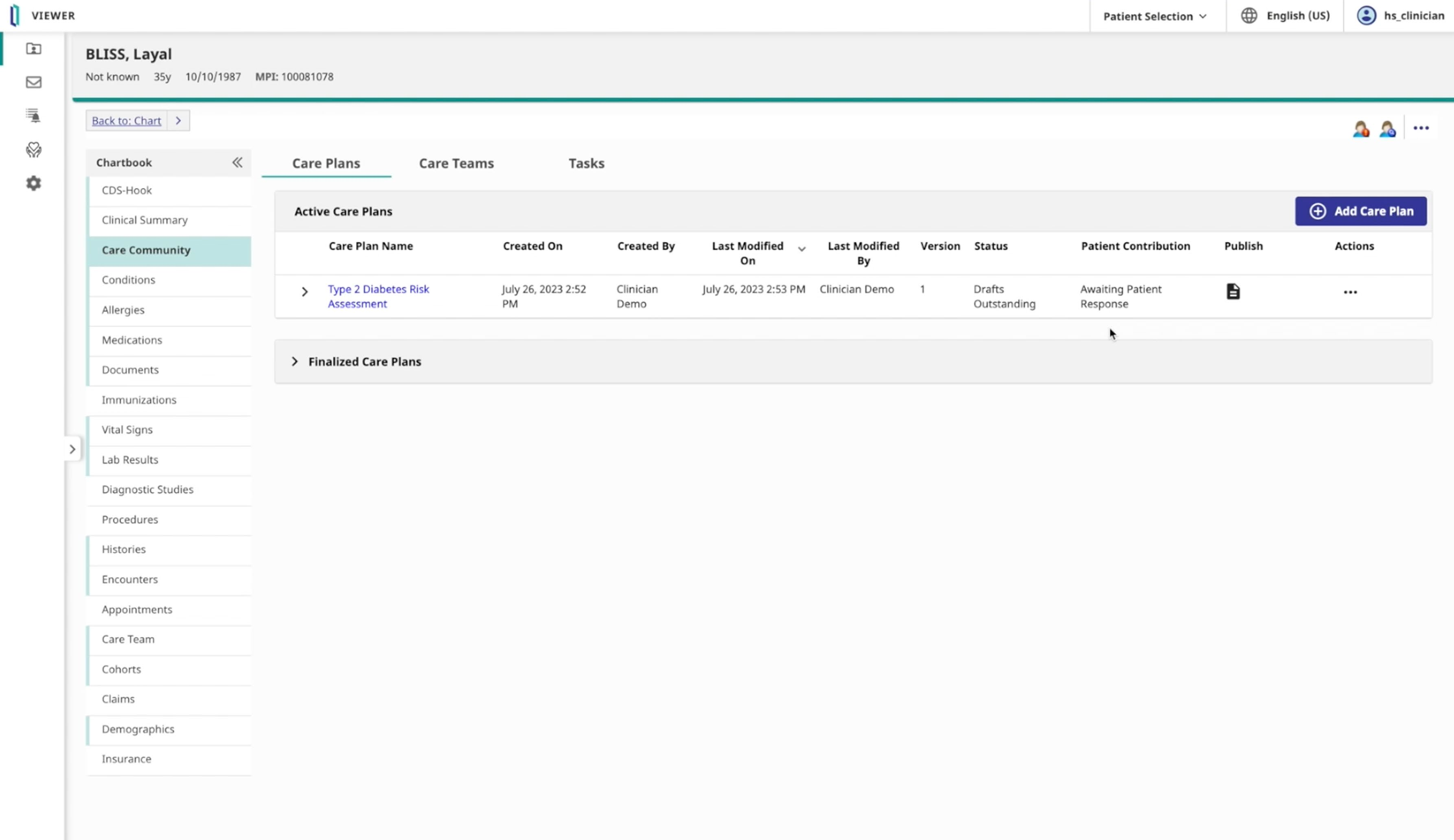
Coordinating a care plan. The care team can see a plan's version, draft status and outstanding patient contribution alongside the shared record. This sample screen appears on page 20 of InterSystems' 2023 healthcare-solutions presentation. It is a vendor demonstration, with sample patient data and no product build stated. Select the image to open it at full size.
Role in the HealthShare Suite
Care Community is part of the HealthShare product taxonomy and is described as complementing Unified Care Record. It should be analysed as care-management workflow and care-plan coordination, not as the UCR repository or the Clinical Viewer itself.
The strongest accessible technical evidence found in the 2026-06-21 pass is not a full Care Community implementation manual. It is the HealthShare Personal Community Patient Entered Data setup guide, which states that Care Community must be integrated so patients can view and complete care plans in Personal Community. The guide records Care Community 2023.1 patient-contribution capability and describes Unified Care Record service-registry and Workbench configuration for Care Community care plans, including the /api/healthshare-rest/<Care Community namespace> route, Care Community assigning authority, and service-registry name.
Current Version Check
The July 2026 public Care Community permission alert is a new evidence trigger for this component. Use the HealthShare support-alert boundary to request the deployed build, effective permissions and correction evidence before relying on RBAC positioning; the advisory does not establish Lincolnshire's configuration or exposure (SRC-295, checked 2026-09-08).
Customer Signal
InterSystems' Care Community resource says Lincolnshire NHS uses HealthShare to power an integrated care portal and uses Care Community for individualised care plans for local care teams and patients. It also reports over 6,000 individual patient care plans and six care-plan types. This is useful customer-direction evidence, but it remains vendor-published; use it as a target for NHS/customer confirmation rather than as independent deployment assurance.
Evidence Status
Confidence is high for vendor positioning and for the Personal Community to Care Community integration mechanics described in current public technical documentation. Confidence is moderate for the Lincolnshire NHS deployment signal because the evidence is vendor-published. Customer evidence is still needed for configured care-plan templates, task workflow, patient/proxy access, FHIR resource use, notifications, local clinical governance, data-sharing, clinical-safety ownership, and current operational status.
The unresolved evidence is a component-specific implementation gap, not a reason for a new page, checklist, request pack, or evidence-domain layer. Hold the gap in the Evidence Validation Queue until current technical documentation, customer-side evidence, or an assurance decision appears.
Related Pages
Follow-up Evidence
- Direct Care Community technical and configuration documentation, if accessible beyond the Personal Community integration guide.
- Lincolnshire ICS/NHS customer-side evidence for care-plan and care-team workflows.
- Evidence for FHIR resource use, RBAC, audit, DPIA/DSA, clinical safety, and operational ownership in a named deployment.