HealthShare Provider Directory
This page tracks HealthShare Provider Directory within the HealthShare family.
Supported Positioning
InterSystems positions Provider Directory as a master data management solution for provider data. The product page says it collects, consolidates, deduplicates, validates, searches, and publishes provider information, using a linkage engine and business rules to create master records for providers and provider organisations.
The current public fact sheet gives stronger feature detail. It frames Provider Directory as provider data management / MDM that can compile provider, organisation, network, plan, location, and relationship data from multiple source formats into a golden record. Publicly stated features include a Data Steward portal, source and date filtering, source-trust hierarchies, survivorship rules, change-source tracking, source-record review, removal of unwanted updates, FHIR APIs aligned to DaVinci Plan Net resources, public REST APIs for provider and provider-organisation records, and on-premises or fully managed-service deployment.
The 2026 InterSystems product advisory also creates a useful product/version boundary: all Provider Directory versions up to and including 2025.2 are affected by an HSMOD.MDM.MasterHistoryEventD storage-growth issue, with fix HSPD-11325 listed for Provider Directory 2026.1 and future releases plus patches for older versions.
User Interface
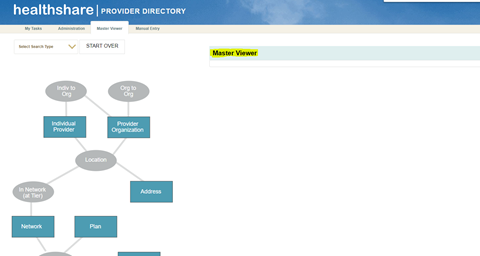
Historical Master Viewer, 2019. This application screen uses provider, organisation, location and network relationships as navigation. It was published in Ravi Nagpal's Developer Community question on 22 February 2019. No records are displayed and the exact release is not stated. The current Data Steward portal may differ; this small original is retained as a historical interface example. Select the image to open it at full size.
Role in the HealthShare Suite
Provider Directory is part of the HealthShare product taxonomy in current InterSystems documentation and product navigation. It should be analysed as provider-data management, not as patient identity, clinical viewing, or a shared-care-record datastore.
Evidence Status
Confidence is high for vendor positioning, listed product features, and the public product/version boundary. The fact sheet is largely US regulatory / payer oriented, so its FHIR Plan Net and CMS references should not be converted into NHS ODS/SDS support without separate evidence.
There is now a historical UK deployment signal. J2 Interactive says Coordinate My Care selected InterSystems in 2015 and that the Phase 1 implementation included a searchable clinician registry using HealthShare Provider Directory, NHS Smartcard access, PDS integration through Spine Mini Services, migration, and testing. UCP / OneLondon sources show CMC was later ceased / rebranded around 31 March or 1 April 2022 and replaced by Universal Care Plan, with InterSystems acting as processor / white-label service during transition. This supports a legacy London usage signal, not a current live Provider Directory assurance claim.
The current UCP breadth check reinforces that boundary. Current public UCP / ICB / supplier evidence points to UCP as the successor service, with access through the UCP web portal, London Care Record, local EPR routes, Better / Valida guidance, National Record Locator integration, and supplier/integration evidence around Better and ReStart/Qvera. It does not name InterSystems or HealthShare Provider Directory as the live UCP platform, directory, or ODS/SDS owner.
Deployment evidence is still needed for current data sources, authoritative-provider-data policy, governance, update/push patterns, hosting model, ODS/SDS mapping, local synchronisation, audit, and UK-specific provider identifiers.
The public July 2026 support notices also introduce a version-specific SSO check for Provider Directory. Use the HealthShare support-alert boundary alongside the existing storage advisory; neither notice proves customer exposure, correction status, or NHS ODS/SDS integration (SRC-295, checked 2026-09-08).
NHS England Directory Boundary
For a DSIC-aligned England deployment, Provider Directory should be tested against national organisation and directory services rather than treated as a generic local directory:
- ODS manages organisation identifiers and reference data for health and social care; NHS developer guidance says ODS codes support organisation lookup, GP-practice lookup, validation of codes in messages/reports, and GP Connect data-sharing boundaries.
- ODS API guidance supports searching organisations, retrieving details for an ODS code, relationships, succession, and modified-organisation lists for local synchronisation. Current ODS news also highlights 2026 migration/data-quality changes around dynamic geography and the FHIR R4 API.
- SDS remains relevant for Spine-connected message addressing and endpoint lookup, while ODS is the safer source family for provider/organisation codes and reference data in this identity-directory pass.
The resulting position is bounded: Provider Directory is a plausible HealthShare provider master-data component, but an England assurance claim still needs product/version evidence, ODS/SDS mapping, data-source authority, synchronisation design, directory stewardship, audit, local role model, safety ownership where workflow is affected, and customer deployment artefacts.
Assurance Questions
| Question | Current public evidence | Remaining proof needed |
|---|---|---|
| Product and version scope | Public product features are clearer, and the 2026 advisory proves that Provider Directory has identifiable version and patch boundaries. | Named customer product/version/build, licensed component list, support status, and upgrade / patch evidence. |
| Data stewardship | The fact sheet supports Data Steward portal, source filtering, trust hierarchy, survivorship, change history, and source-record review capabilities. | Deployment-specific stewardship policy, accountable owner, source priority rules, exception workflow, audit review, and data-quality measures. |
| NHS organisation directory integration | ODS evidence defines the organisation-code, relationship, succession, validation, and local-synchronisation requirements that an England deployment should satisfy. | Direct Provider Directory mapping to ODS APIs, ODS-code model, dynamic-geography handling, sync cadence, conflict handling, and evidence of local validation. |
| Spine / endpoint / role directory integration | SDS remains relevant for Spine-connected endpoint and message-addressing context. | SDS endpoint / role / workgroup mapping, certificate / endpoint ownership, message-addressing design, and audit evidence. |
| Historical UK usage | Coordinate My Care is a historical signal that Provider Directory was reportedly used for a searchable clinician registry in a HealthShare implementation, but CMC later transitioned to UCP. | Current customer-side architecture, DPIA/DSA, DCB0129/DCB0160, live-service status, data-flow diagrams, and procurement or FOI evidence naming Provider Directory. |
| API and consumer model | InterSystems states FHIR Plan Net and REST API support. | NHS profile mapping, access-control model, API consumer list, rate/monitoring model, information-governance approval, and safety assessment where workflow depends on directory data. |
Evidence Request
Use the assurance questions above as a request pack only when Provider Directory is being relied on for a current implementation claim. Ask the supplier or customer to provide:
- Product/version and licensed scope: Provider Directory version/build, licensed modules, hosting model, managed-service boundary, support status, and any current patches or upgrade plans.
- ODS/SDS mapping: ODS API or file sources, ODS-code model, dynamic-geography handling, SDS endpoint/role/workgroup mapping, synchronisation cadence, conflict handling, and local validation evidence.
- Data stewardship: authoritative sources, source-trust hierarchy, survivorship/update rules, accountable data steward, exception workflow, audit-review process, and data-quality reporting.
- Governance and safety: DSA/DPIA, controller/processor matrix, DCB0129 supplier safety case, DCB0160 deployment safety case, hazard log, access/RBAC/audit design, change control, and incident process.
- Deployment proof: customer architecture, data-flow diagram, live-service status, connected systems, API consumers, runbook, monitoring/support model, and evidence that Provider Directory is explicitly named and current.
Related Pages
Follow-up Evidence
- Current Provider Directory technical and data-governance documentation, including synchronisation, audit behaviour, and the product/version/build affected by any deployment.
- Evidence for ODS/SDS mapping, local authoritative-source choices, provider-data stewardship, role-model ownership, and update / survivorship rules.
- Customer, procurement, DPIA, DSA, clinical-safety, FOI, or implementation evidence where Provider Directory is explicitly named and current, especially if any current UCP / London service architecture is said to retain an InterSystems component.