InterSystems FHIR Server
This page tracks the source-backed technical evidence for InterSystems FHIR Server.
User Interface
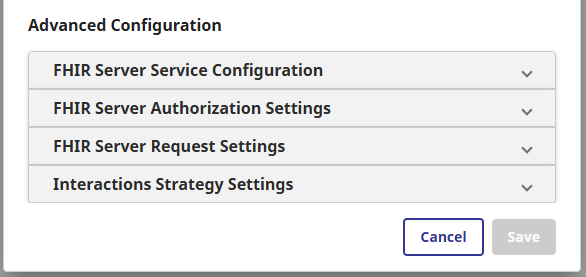
Configuring a FHIR endpoint. The administration screen groups service, authorization, request and interaction-strategy settings. From the Cloud Services documentation, checked 15 September 2026; the screenshot build is unspecified. Select the image to open it at full size.
Supported Positioning
InterSystems documentation describes InterSystems FHIR Server as a cloud SaaS repository for storing healthcare data as FHIR resources and exposing that data through REST APIs. Current cloud-service documentation also positions it for FHIR storage, search, analytics, SMART on FHIR application back ends, and bulk-data back ends.
The broader InterSystems FHIR server architecture also supports an out-of-box server backed by the Resource Repository. That architecture can store and retrieve FHIR resources from an InterSystems database, can be customized, and can optionally route requests through an interoperability production, though the documentation says routing through a production is not required.
Technical Shape
- Cloud-service documentation groups the FHIR Server material with release notes, FHIR concepts, supported interactions and operations, deployment, configuration, security, maintenance, profiles/packages, Bulk FHIR Coordinator, and FHIR SQL Builder.
- Cloud Services Portal documentation describes deployment-level choices for InterSystems cloud services including cloud provider, region, tenant, deployment size, high availability, and service-level settings.
- The Resource Repository is documented as the default storage strategy for an InterSystems FHIR server and as sufficient to install a functioning FHIR server without new backend development tasks.
- A custom backend is possible, but it requires custom FHIR processing logic; where a product is not licensed to install the FHIR server, the FHIR Adapter for interoperability productions is the documented alternative boundary.
- Cloud FHIR security documentation describes OAuth 2.0 resource-server configuration and access-token checks for FHIR requests. InterSystems Network Connect separately documents secure VPN or private-circuit connectivity for cloud-service deployments.
Product Version and Managed-Service Boundary
IRIS for Health 2026.2 adds FHIR tooling, authentication configuration and ingestion options described on IRIS for Health. This is product release evidence; it does not confirm rollout to the managed FHIR Server service or a particular tenant. The profile-validation page separates structural checks from profile validation.
July 2026 vendor alerts create concrete FHIR audit, access-control and maintenance checks. Use the support-alert boundary with the actual product/build and correction record, rather than inferring either exposure or remediation from the FHIR Server name.
Evidence Status
Confidence is high for documented architecture, cloud-service positioning, FHIR security mechanisms, deployment-choice concepts, and secure cloud-connectivity patterns. The page does not by itself establish a named UK hosting region, customer-specific tenancy, contract service levels, information-governance arrangements, or GP Connect assurance status.
Related Pages
- InterSystems FHIR Services
- FHIR Packages and Profiles
- Bulk FHIR Coordinator
- InterSystems OMOP
- SDA and CDA Transformation
Remaining Follow-up Evidence
- Customer-specific service-level, hosting-region, backup, monitoring, support, and tenancy documentation for UK healthcare use.
- Healthcare compliance and information-governance material for managed FHIR service use.
- Customer or procurement evidence where InterSystems FHIR Server is explicitly named.