HealthShare
This page tracks HealthShare from the official InterSystems UK healthcare product set.
For source routing across HealthShare components, standards relevance, deployment evidence, AI Assistant boundaries, and DSIC adjacency, use the HealthShare Components Evidence Domain. It is a navigation layer over Sources and Evidence Matrix, not a substitute for source IDs.
Official InterSystems Positioning
InterSystems positions HealthShare as an advanced interoperability platform and connected-care suite for capturing information, sharing it meaningfully, supporting understanding, and driving action across organisations and communities.
User Interface
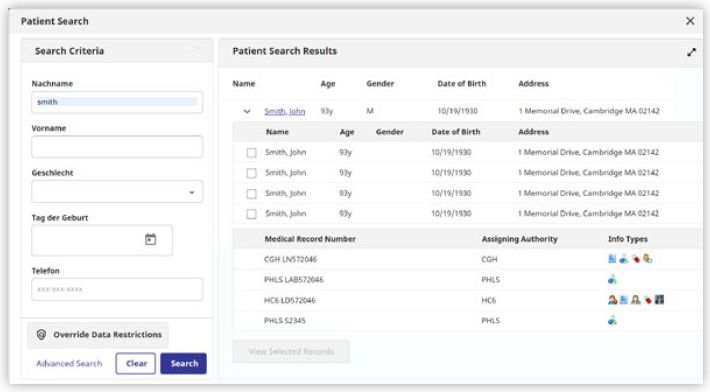
A component of the suite. This example shows Clinical Viewer patient selection, one user-facing route into the HealthShare longitudinal record. HealthShare is a family of applications, so this screen does not represent every component. Published in the InterSystems Clinical Viewer brochure; release and customer configuration are not stated. Select the image to open it at full size.
Role in the Portfolio
HealthShare is the connected-care and interoperability family. Current InterSystems documentation and product navigation identify HealthShare 2026.1 products including Care Community, Clinical Viewer, Health Insight, InterSystems EMPI, Personal Community, Provider Directory, and Unified Care Record; separate product pages also position Health Connect as a HealthShare-related integration engine. The detailed HealthShare 2026.1 documentation index is public, but much of the underlying documentation requires WRC login.
Component Split
| Component | Role in this wiki |
|---|---|
| HealthShare Unified Care Record | Longitudinal shared-record and data-unification proposition. |
| HealthShare Clinical Viewer | Clinical presentation layer for browser, mobile, and embedded access to HealthShare/UCR information, with historical H&W ICWR DPIA deployment-context evidence. |
| HealthShare EMPI | Enterprise master person index / identity-resolution component. |
| HealthShare Provider Directory | Provider master-data management component with public data-stewardship, API, managed-service, and product/version evidence. |
| HealthShare Health Insight | Analytics companion to UCR for population, clinical, business, and workflow insight. |
| HealthShare Personal Community | EHR-neutral patient digital-front-door product connected to HealthShare and EHR product navigation. |
| HealthShare Care Community | FHIR-enabled care-management and care-plan workflow component that complements UCR, with accessible Personal Community integration evidence for patient-contribution care plans and a vendor-published Lincolnshire NHS care-plan signal. |
| HealthShare AI Assistant | Generative-AI assistant capability operating within Clinical Viewer and the Navigation Application, with public sample deployment files but account-gated detailed documentation. |
| Health Connect | Integration-engine product related to the HealthShare family; see its deployment choices. |
Evidence Status
Confidence is high for vendor positioning and component taxonomy. HealthShare has additional UK evidence in this wiki through Birmingham / West Midlands validation, PRSB Core Information Standard conformance, NHS supplier-progress evidence, Programme CORTISONE evidence, published DPIAs, FOI records, and customer-side EPR/shared-care-record sources, but configured capabilities, local data flows, and operational outcomes still vary by deployment.
BSMHFT's FOI 052/2025 strengthens the named-customer evidence: it identifies HealthShare and a £4 million collaborative Shared Care Record contract across Birmingham and Solihull, Coventry and Warwickshire, and Herefordshire and Worcestershire through April 2029. It does not identify every licensed component or establish the post-March 2026 scope of the separate MERIT contract. See Birmingham and West Midlands Validation.
Public Support-Alert Boundary
The 2026-09-08 review found public vendor alerts dated 22 July 2026 that turn several generic assurance gaps into specific product/version checks. The table records the published affected ranges, not whether a particular installation remains affected after corrections.
| Public alert | Published scope | Evidence needed in a deployment |
|---|---|---|
| HS2026-01-01: unsafe Care Community permission | Care Community before 2025.2. | Permission configuration and correction status. |
| HS2026-01-02 / 04: FHIR authentication logging and chained-search access | UCR, IRIS for Health and Health Connect: 2020.2 onward for logging; 2024.1 onward for chained search. | Applicable fixes, audit tests and access-control tests. |
| HS2026-01-03: federated SSO regressions | UCR, Clinical Viewer, Provider Directory, Health Insight and EMPI 2025.2. | SSO configuration, correction and regression evidence. |
| HS2026-02-01 / 02: upgrade failure or additional downtime | Specified IRIS for Health / Health Connect maintenance upgrades and older IRIS for Health / UCR upgrade paths. | Exact source/target builds and the vendor upgrade-impact guidance. |
| HS2026-02-03 / 04: consent and fetch behaviour | UCR: all versions in the PIX/DSUB consent alert; 2024.2–2026.1 in the fetch-timeout alert. | Consent enforcement, fixes and operational tests. |
The full HS2026-01 notice also identifies FHIR reset and SQL Builder deletion cases. The HS2026-02 notice supplies the precise upgrade ranges. Use the detailed vendor alert and WRC correction record for remediation decisions; a broad version range is not proof of an unpatched customer system.
The Clinical Viewer page adds public patient-banner and UK NRL pointer-labelling evidence. These are stronger implementation-specific questions, while customer identity, local exposure and completed remediation remain unproven.
Anchor Audit Notes
The current HealthShare anchor model remains component-based. HealthShare should be read as a product family and connected-care architecture, not as a single deployable feature or a full GP foundation clinical system. Component, customer, and assurance claims need separate evidence:
- Unified Care Record and Clinical Viewer support shared-record and direct-care viewing patterns; Clinical Viewer access, SSO/RBAC/audit, AI Assistant adjacency, and deployment assurance need the separate high-risk audit on the standards product map.
- EMPI and Provider Directory support identity and provider-data functions. The 2026-06-21 PDS/ODS pass strengthens the NHS England dependency boundary: PDS FHIR creates concrete NHS-number, synchronisation, invalid/superseded-record, local back-office, and safety requirements; ODS creates organisation-code, relationship, succession, validation, and local-synchronisation requirements. The 2026-06-28 Provider Directory pass adds stronger public product-feature and version-boundary evidence, plus a legacy Coordinate My Care usage signal. The current UCP check points to Better / Valida / London Care Record / UCP web portal / National Record Locator routes, not a current InterSystems Provider Directory role, so it still does not prove current EMPI or Provider Directory PDS/ODS/SDS implementation.
- Health Insight supports analytics use cases.
- Personal Community and Care Community support patient-facing and care-management patterns where licensed and configured; Care Community now has accessible Personal Community integration-mechanics evidence, but not independent deployment assurance.
- Health Connect supports integration, routing, transformation, and operations patterns adjacent to HealthShare.
- HealthShare AI Assistant is a current product capability with public launch/sample evidence, but UK clinical-safety and governance proof remains open.
- DUAA adds a statutory standards/data-governance layer for England health/adult social care IT and IT-service providers, but does not change the HealthShare product taxonomy or prove any HealthShare deployment compliant.
This anchor check leaves the main unresolved model gap in the Evidence Validation Queue: which HealthShare components are licensed, configured, safety-assessed, integrated, and live in a named customer or DSIC-relevant deployment.
Related Pages
- HealthShare Unified Care Record
- HealthShare Clinical Viewer
- HealthShare EMPI
- HealthShare Provider Directory
- HealthShare Health Insight
- HealthShare Personal Community
- HealthShare Care Community
- HealthShare AI Assistant
- Health Connect
- HealthShare Components Evidence Domain
- Birmingham and West Midlands Validation
- NHS Connectivity and GP Connect
- Standards and Interoperability
- Data (Use and Access) Act 2025
- Programme CORTISONE / UK Defence Healthcare
Remaining Follow-up Evidence
- Public HealthShare technical architecture and component product documentation beyond the account-gated HealthShare 2026.1 index.
- Public module-level implementation documentation for Health Insight, EMPI, Personal Community, Provider Directory, and AI Assistant. For EMPI / Provider Directory, prioritise PDS FHIR onboarding, ODS/SDS mapping, local synchronisation, stewardship, audit, safety-ownership, and current customer-side evidence. Direct Care Community configuration remains useful only if Lincolnshire or another customer-confirmation requirement is opened.
- Implementation-specific evidence showing configured components, data flows, and governance.
- Independent outcome evidence for connected-care deployments.
- Supplier, customer, or catalogue evidence proving the exact role split when HealthShare is part of a DSIC-relevant architecture.